
THE FUTURE OF WORK TALE AS TOLD BY THE LUDDITES
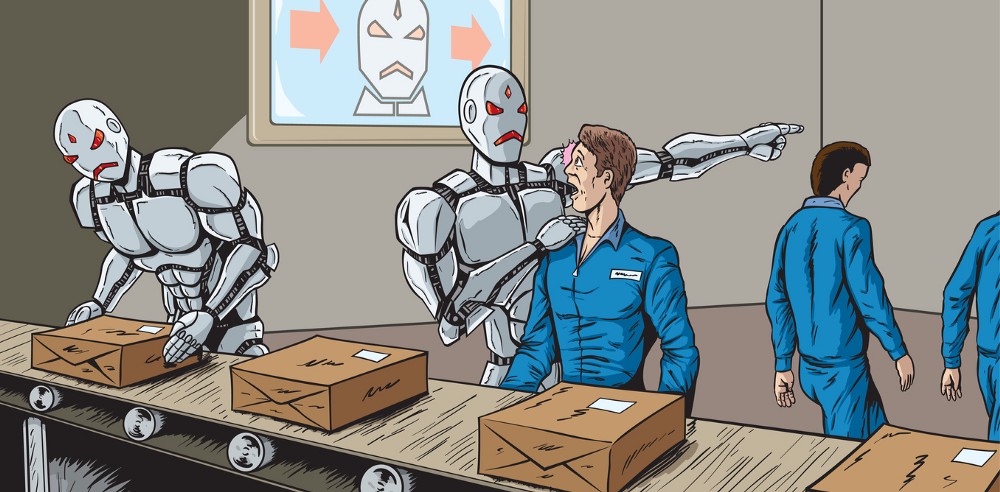
It was the year 1823, in the gallows with the noose around their neck were fourteen people to be hanged. Amongst these condemned men was a 16 year old boy crying out to his heart-broken mother in the watching crowd to help him.
But the boy’s mother was powerless to do anything that could save her son. She could only wail in despair and watch-on with a broken heart, as the final orders where given and her son struggled to fight with his last strength, the suffocating and biting pains brought by the rope around his neck. In no-time, the boy hung lifeless, his body swirling slowly from side to side as if to wave a final goodbye to a world he could not seem to understand.
The crowd looked on in helpless grief at the fourteen lifeless men, some of them fathers, husbands and lovers, brothers and uncles. This sentence to death by hanging was issued from the highest place of government, the crime committed was that these men where luddites.
Their jobs and means of livelihood were under attack by advancing technology, and they fought back the best way they knew. And so ended their tragic heroism; their story forever a testament that; technology and automation has the power to disrupt both positively and negatively.
Whenever an article about job loss due to technological advancement and automation is written, the Luddite story is always used as the perfect exemplum.
So who were the luddites and what crime did they commit really?
The Luddite movement began around the year 1810, it was made up of men whose profession at the time was in the textile industry. This included weavers, stocking makers and embroidery specialist. These were high paying professions at the time, but soon, new types of machines were invented. These machines could automate the work of making stockings and textile making with very little human input.
This resulted in entrepreneurs with access to huge capital to set up big factories, which in turn led to more and more handcraft workers going out of employment. These former craftsmen formed themselves into groups called the luddites and went about destroying the new machines, burning the factories and even killing some factory owners.
The issue escalated into a national threat, which involved the British parliament passing legislation against luddites who destroyed machines or burned down factories. Thousands of soldiers were deployed to the towns where the Luddite movement was prominent, and after a number of clashes, the Luddite revolution was eventually subdued by force and a show of public execution by hanging as the one described earlier.
The looms that marked the Luddite movement are today weaving threateningly around our world at a global and existential level. Our only safeguard is to learn and adapt the lessons from this momentous historical face-off between man and machines; as they contend for supremacy in the job market.
Just like the Luddite narrative where different stakeholders (workers, factory owners, & government) had a significant role to play in the final outcome of the story, the job disruption face-off we will experience going forward into this new era will also require the pro-active harmonization of thoughts, policies and end goal for all parties. From the individual, to the employers of labor, to regulatory government bodies; all will need to reconcile to the fact that they face a common threat, and that they must be united to defeat this common enemy.
***FUN FACT***
Duriing the Ludite revolution, one of the very few legislators who advocated for the Luddites was Lord Byron. Coincidently, Lord Byron’s only legitimate daughter Ada Lovelace would become the first computer programmer by combining the technology of the Analytical Engine with the Jacquard loom.
This ironic thread has stretched even to our times, and is woven with the looming job-loss predicament we find ourselves today. For AI and Automated Machines need programming which to a great extent can be traced back to Lord Byron’s daughter — Ada Lovelace.
In the coming chapters of this book, I will be discussing some of the possible ways workers/individuals, employers (soon to be employers of robots & automated machines) and government through its legislative arms and agencies can avoid the tragic route of the Luddite-type scenario.
From the one end of the individual laborer to the farthest end of Government policy makers, everyone needs be involved in finding the most agreeable means for dealing with this encroaching robot and AI automated army.
By being futuristic and pro-active, Government will have little need for anti-riot police. On the other hand, owners of industry and employers of labor will have no fear of being stigmatized or attacked by disgruntled workers. And most importantly, the worker whose job will be swallowed up in the robot and AI automation deluge will find solace in the fact that they had anticipated such a scenario and prepared for it long before it could affect them negatively.
- Published in 4IR, Artificial Intelligence, Business & Economy, Digital Transformation, Fourth Industrial Revolution, Future of Work, Futurism
DANGEROUS ARTIFICIAL INTELLIGENCE – BIG BROTHER ALGORITHMS


According to statistics, people spend an average of 4hrs 25min of their time online, and at least over 2 hours of their time on social media daily.
As immersive technologies like VR and AR become more available, this number will increase.
A major aspect of our perception will undoubtedly be shaped by the content we digest from these platforms where we spend our time. The caveat here is that a majority of the content we see on our feed is determined by ruthlessly-efficient algorithms. Even the results we get on Google search are determined by independent algorithms.
Recently (sometime in 2019), Google’s CEO, Sundar Pichai was summoned before the United States Congress to explain why an image search for the word idiot will show picture after picture of President Trump. Many of the other congressmen also complained about the negative connotations that came up with their name search. The response of Google’s CEO was simple. There were robot algorithms controlling these results that even Google’s CEO himself could not tweak to favor the president of the United States. Even national issues such as a country’s election can now be affected by the way algorithms are made to swing on social media (Case of Facebook/Cambridge Analytical).
These algorithms were initially designed to keep us engaged, but as they get more efficient, our access to ‘non-masterminded’ varying sources of information becomes more limited.
You are targeted by marketers and ads that study your online behavior and know your location at every given time. You are recommended friends within a closed loop of former school mates, family members, similar interests, etc. You are inherently forced to live within a closed-loop or bubble of familiars.
For example, say you are struggling to come out of the habit of gambling but the majority of your friends on social media are still actively engaged in the practice. The social media algorithm that controls your feed will know no better but to do that which will reinforce the habit by showing content related to gambling and recommending you more gambling friends.
In the case of politics, if the majority of your friends are left-winged or members of a particular party, then the majority of the contents you would see will be biased. You may always end up having a partial or one-sided account on issues that need balanced dialectics. Issues such as one-sided or even fake news will continue to grow, fueled by algorithms that are smart enough to maximize engagement but not smart enough to discriminate against sentiments.
On a personal level, you and I must make conscious effort to systematically and occasionally weed out our online gardens (especially social media platforms). Periodically review your personal and business brand presence. Take cognizance of what appears when you or your business name is searched for online.
Be careful of the people you connect with, the groups you join, the nature of discussion you publicly contribute to; because the algorithmic big brother eyes of the Machine Learning Lord is watching you. Remember your digital presence and identity as a real person. People have fallen in love or gotten jobs worth millions online without any physical meeting. As technologies such as AR & VR gain more powers and become more ubiquitous, more premium and reality will be placed on the digital manifestations of ourselves on platforms such as social media.
Not to be as audacious as the ideas proposed by movies such as the ‘Matrix’, ‘Surrogate’ or the more recent ‘Ready Player One’ movie, we can say with some certainty that now and in the future, people will live two separate lives, one physical and one digitally virtual. Going into the 2020s and beyond, our digital life and realities will begin to take the ascendency over our physical lives.
It is essential therefore that you begin to cultivate and guard it jealously from the hands of a big-brother algorithm designed with one purpose only – to make profit off of your digital soul at any cost.
To your success and mine in the coming months and years.
Note: This article piece is an excerpt from my book, 2020s & The Future Beyond. Click here to learn more.
**********************************************************

2020s & The Future Beyond, is a book that dives deeply into what the future of this decade and the ones that will come after will look like; especially as it relates to the development of AI and other emerging technologies. Click here to learn more.
- Published in Artificial Intelligence, Futurism
Emerging Controversies: The Vatican, The Pope, AI, & The Future of the World


On February 28th, 2020, the Vatican through one of its institutions, the Pontifical Academy for Life; released a document titled, Rome Call for AI Ethics.
According to the Vatican representative; “The Call’s intention is to create a movement that will widen and involve other players: public institutions, NGOs, industries and groups to set a course for developing and using technologies derived from AI. From this point of view, we can say that the first signing of this call is not a culmination, but a starting point for a commitment that appears even more urgent and important than ever before.
Why is the Pope, the religious head of the Roman Catholic Church sanctioning the Church & it’s institutions to lead conversations for AI, and AI ethics?
Why will Microsoft & IBM, two of the world’s biggest private firms with sophisticated AI tools and data resource of sovereign Nations; cross from one end of the world, over miles and oceans, and head to the Vatican to sign a document championed by the Roman Catholic Church on how AI should be regulated for everyone on earth?
How did the church slowly, but surely now, become the epicenter for converging complex discussions on politics, socio-economic policies, global religion and even the biographical definition for everyone’s life on earth?
While the issue of AI and its regulation is pivotal and necessitates stakeholders around the globe to be involved-in it, the fact that a religious institution, not just anyone, the Roman Catholic Church (whose history of the dark ages remains indelible in the marked and unmarked graves of millions of martyrs), has as a lamb without horns, ‘unsolicitedly’ stepped into the role of leading the conversation for defining the moral framework that will shape the future of humanity – this should be a big cause for concern to anyone who cherishes what liberty of conscience should mean.
The issues before us as we wade into the waters of the next decade are existential; here is an excerpt from Pope Francis’s remark on the event;
“On the personal level, the digital age is changing our perception of space, of time and of the body. It is instilling a sense of unlimited possibilities, even as standardization is becoming more and more the main criterion of aggregation. It has become increasingly difficult to recognize and appreciate differences. On the socio-economic level, users are often reduced to “consumers”, prey to private interests concentrated in the hands of a few. From digital traces scattered on the internet, algorithms now extract data that enable mental and relational habits to be controlled, for commercial or political ends, frequently without our knowledge. This asymmetry, by which a select few know everything about us while we know nothing about them, dulls critical thought and the conscious exercise of freedom. Inequalities expand enormously; knowledge and wealth accumulate in a few hands with grave risks for democratic societies. Yet these dangers must not detract from the immense potential that new technologies offer. We find ourselves before a gift from God, a resource that can bear good fruits.”
The points raised by the pope are factual and deeply worrisome. In a few years the clear sign of their implication will be felt globally if steps are not taken to remedy the situation. The need to deal with these issues is now. The only problem is who would be eligible and responsible for leading this response. Government’s around the world are so embroiled with internal political squabbles, political leaders around the world only have one thing as a priority on their list – how to get elected or re-elected. The biggest nations of the world (US, China, Russia et al) are either embroiled in cold cyber wars, trade-wars or struggle for political relevance at home and abroad. The UN over time has mostly become a diplomatic institution, responding to crisis only as it is able to clear the numerous backlogs of world problems on its list.
So against this backdrop, who is the best candidate that the entire world can give the mantle and responsibility of charting the next course of its history? Who has the breadth of network that can steer the ship of the future in waters where it will have to meet storms caused by the winds of morality and ethics? Who can apply both physical and metaphysical definitions for rationalizing consciousness and the ‘why’ of human existence?
It appears all these questions have been rigged for a singular answer. An answer that has manifested itself in the person of the Pope, who in no way has shied from beginning his duty of leading the human race into a ‘new age’ or a ‘new world order’.
And so, new questions arise; Can the world trust the Vatican? Can the world trust the Pope?
John Kelly, IBM’s executive vice president who represented IBM at the event had this to say,
“AI is so close to human behavior and interaction this is really important to get right, so we are really proud to team up with the Catholic Church to get this one right.”
Brad Smith, Microsoft’s president, who signed the document on behalf of Microsoft said: “I think it’s a challenging time because there is so much polarization in so many parts of the world…We need people who can work to close the gaps that divide us – so in some ways I look at the Catholic Church, I look at a company like Microsoft, and I say why not?”

Some other people who signed the document included UN Food and Agricultural Organization director Qu Dongyu (who I personally believe was specifically chosen to represent the UN in this accord because of his Chinese nationalism) and Italy’s technology minister Paola Pisano.
So why make a big deal out of all this? After all, this seems like a good progress for humanity.
First off, I believe the church must be a channel of good to the world, and at all times it must do all the good it can for everyone on earth. But history has shown that the church or any religious establishment has ‘never not’ been intoxicated by the wine of power when it is concocted for it to drink – especially when such wine is brewed with a global flavor. The church must stand on its own, and the state or government institutions must stand on their own. In fact, this is the very reason why the United States as a nation came to be. The founding fathers of America, having gone through and seen what the cruel dictation and persecution of religious despots with state power can mean to the freedom of expression and the liberty of conscience, decided to build a nation right out from the virgin earth. A nation with all the attributes of a lamb (but may end up speaking like a dragon if care is not taken). A nation that has prospered and stood for absolute separation of Church and State, backed by the firm foundations in its Bill of Rights which proscribes that there be no room or advantage for governments’ pandering to religion of any kind.
It is Ironic that this ideology fought for by the founding fathers of the US has begun to lose its deep rooted implications in the eyes of their posterity. That two of the nation’s biggest tech companies (IBM & Microsoft), housing the data of millions of citizens including those of billions of people from different Nations over the world, would stretch their hands back over the breach that was painstakingly created, just so they can come into fellowship and put the fate of the future of humanity in the hands of their father’s arch enemy; must be the worry of all people who understands what it truly means to live with a liberty of conscience.
The precedence has been initiated, the United Nations through one of its representatives was a signatory, Italy through one of its minister was also a signatory, in time, many more companies and nations will join into this alliance with the view that the Pope and the Roman Catholic church would lead the conversation for how Artificial Intelligence should shape the future of humanity.
For this alliance to move progressively, fundamental views on morality, doctrines and philosophies will need to be harmonized. Issues such as consciousness, the origin of man, and even transhumanism will need to be given globally acceptable definitions.
Whose view will be subscribed to in all of this? Obviously, it will be that of the Church.

Rome Call for AI Ethics was not just one simple signing of a document. By virtue of this event, the private and public world has shown the world their acceptance of a new world leader. A leader who would be looked-upon to define the narrative for solving complex problems such as; socio-economic disparities, inequality, unemployment, hunger and poverty. Undoubtedly, the world has come to a point where it will have to choose between a form of fascism or continue to face its many malignant and excruciating conflicts like terrorism, wars, sociopathic leaders etc.
Many for-profit corporate organizations already operate with a form of fascism cloaked under the garment of capitalism. Facebook for example with its over 2 billion online citizens (which is approximately a fourth of the entire world population) can confidently refer to itself as a form of digital nation, one where its founder and CEO, calls all the shot. Imagine a situation where Facebook, Google, Microsoft, Amazon, and possibly even the Chinese tech giants etc, backed by data and resources from different sovereign Nations and even global institutions like the United Nation; subscribe to this alliance, what power, what control, will be at the feet of the man or institution that wields it. The Pope is very much aware of this power, as stated in his remark for the event;
“On the socio-economic level, users are often reduced to “consumers”, prey to private interests concentrated in the hands of a few. From digital traces scattered on the internet, algorithms now extract data that enable mental and relational habits to be controlled, for commercial or political ends, frequently without our knowledge. This asymmetry, by which a select few know everything about us while we know nothing about them, dulls critical thought and the conscious exercise of freedom.”
AI should not be seen as just one technology in the list of emerging technologies like Blockchain, Quantum Computing, Virtual Reality, IOTs etc. AI is that one technology that will drive everything else by its ability to breathe the breath of intelligence which can make almost anything come alive.
This decade of the 2020s will be crucial to the shaping of man’s future. Whether the world really needs a world leader, one who will shelve the responsibility of how we use AI to paint the picture of our future, is a complex topic beyond the scope of this article. For the moment, I believe the world must be awakened to the new reality that now stares them in the face. A reality where unlikely partnerships can be formed between private companies from nations founded on religious liberty on one side with religious institutions having perpendicular beliefs and traditions from the other side of the world.
The world has entered into a new era, one where the need to regulate Artificial Intelligence and its implication for the future of man will lead to fornications and strange kinds of intercourse between Nations, merchants and corporate institutions of the world, and medieval institutions with links to Babylon as cryptically described in the bible book of Revelation 18 verse 3. All that can be said for now is this;
“Let all those who have ears; let them hear.”
I just released my book, 2020s & The Future Beyond, which dives deeply into what the future of this decade and the ones that come after will look like especially as it relates to the development of AI and other emerging technologies. Click here to learn more.
- Published in Futurism
Artificial Intelligence Beyond Moore’s Law.


Before 2012, training an AI model to high degree accuracy could take days, now it can be achieved in only a few minutes. This trend of accelerating AI computing has been projected to continue according to report put together by Stanford University in partnership with Google, OpenAI, PwC, Mckinsey & Company, Genpact and AI21 Labs.
If I am to summarize the implication of this report in simple language, it means we haven’t touched the true power of AI yet, and we shouldn’t be too quick to throw away the possibilities of AGI happening within the next few decades.
Moore’s law will continue, yes, but AI will say to Moore’s law, “you are too slow for me, clear road!”
AI development will continue to jump in real leaps within the coming years, and who knows, maybe even pessimistic AI researchers may soon be forced to consider the possibility of AGI development.
Here is a profound excerpt I found on the issue from OpenAI’s report on the research; “Improvements in compute have been a key component of AI progress, so as long as this trend continues, it’s worth preparing for the implications of systems far outside today’s capabilities – OpenAI
I would be happy to hear your thought on this issue, but please, make sure your commentary is objective (this is not an AI takeover the world post).
GLOSSARY
Moore’s Law – Moore’s law has been in existence since the 1960s, the law provides a guide for how the speed of computing doubles every 18months or 2 years. It is this law that makes it possible for newer and powerful phones (Iphone11, Samsung S20 etc) or computers to be launched every year.
AGI – AGI stands for Artificial General Intelligence, it is the point where machine intelligence becomes so effective that it can do almost everything a human can do or even better in some cases.
#2020s & The Future Beyond.
#Iconickelx #ArtificialIntelligence #AGI #Future #Singularity
- Published in Futurism
- 1
- 2