
APPLYING ARTIFICIAL INTELLIGENCE – PREDICTING NIGERIA 2019 ELECTION WITH AI — SENTIMENT ANALYSIS

NOTA BENE: This was an AI project I executed in 2019 during the 2019 elections. It was first published in my Medium blog on the 15th of February, 2019. I decided to republish here on my website for anyone looking for material for research purpose.
PROJECT APPROACH
By streaming data from Twitter in real-time we were able to gather over 800,000 tweets which formed the sample for this analysis.
Data (Tweets) streamed were primary keywords pertaining to the Nigeria 2019 election such as: “PDP”, “Atiku”, “Atikulated”, “Peter Obi”, “APC”, “Buhari”, “Mbuhari”, “Tinubu”, “Osinbajo”, “Lagos”, “Kaduna”, “Kano”, “Abia”, “Delta”, “port harcourt” .
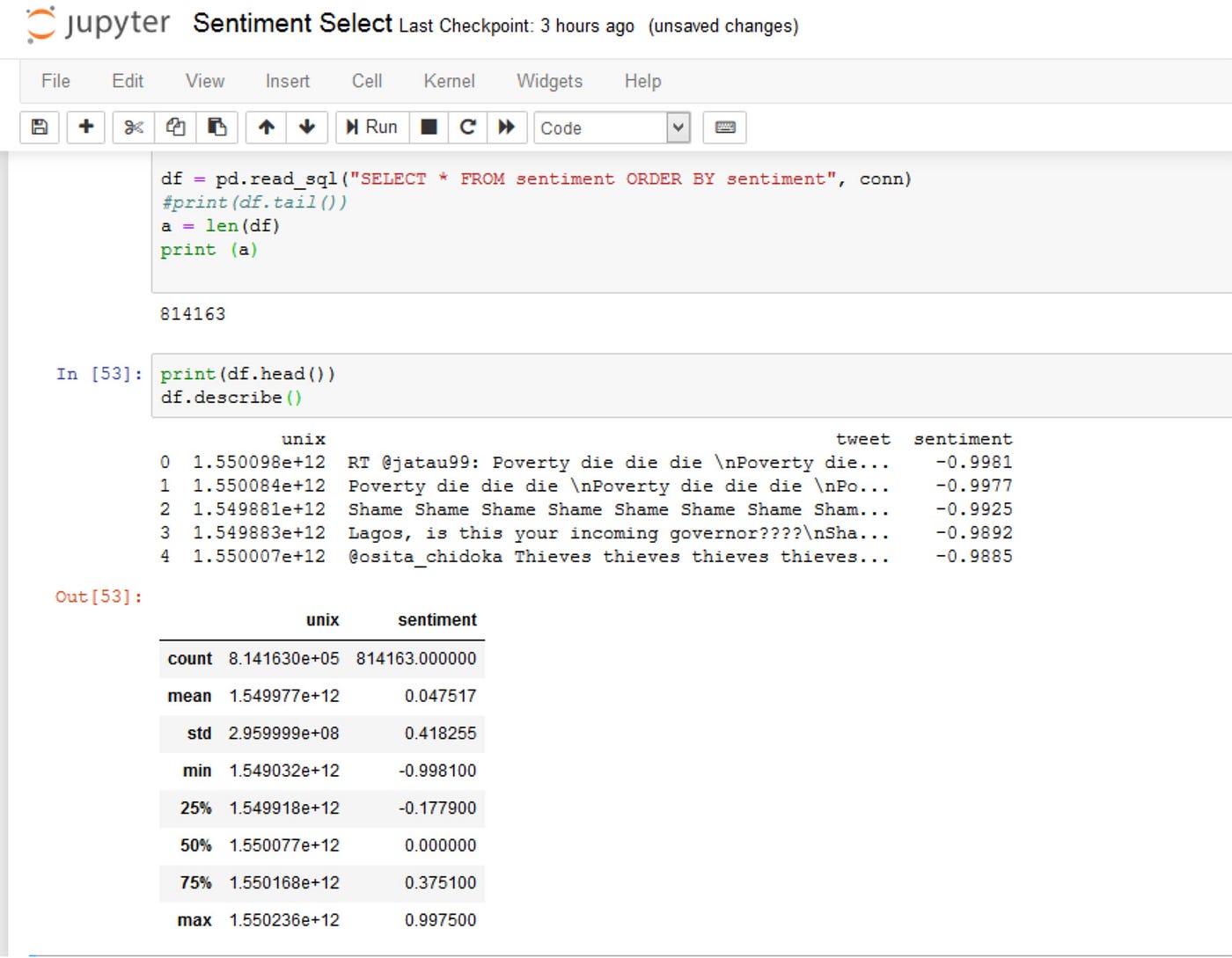
The sentiments of each Tweet was resolved and all values were stored on a database. See data description below.
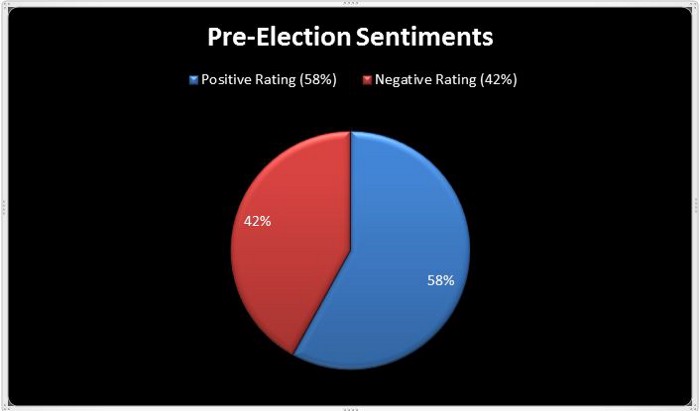
Overall the percentage of Negative and Positive Tweets are 42% and 58% respectively as can be seen from the chart below.
For the Individual presidential candidates, Buhari had a higher number of overall mentions in tweets totaling about 218,519 tweets. Atiku on the other hand had a total mention of 136,149 mentions in tweets.
The distribution of tweets for each presidential candidate is as given below.
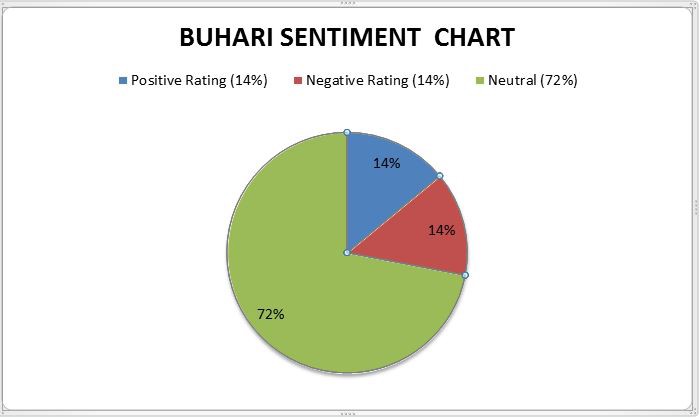
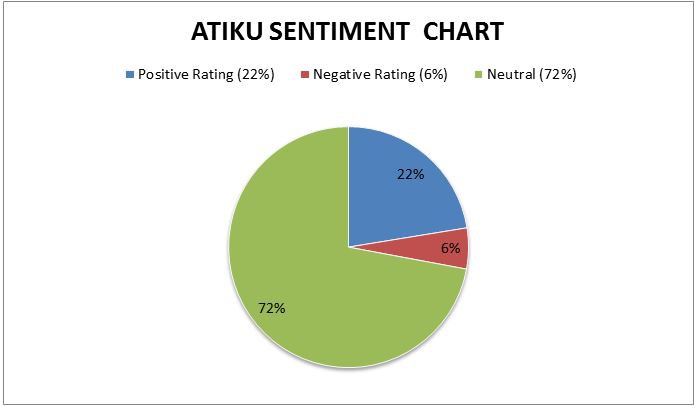
As can be seen in the distribution, Atiku has a higher positive rating in percentage when compared to tweets that mentions him. But this is not the conclusive milestone on our data.
Next we explore sentiment distribution as regards to the two main political parties in question, APC and PDP with a total tweet mention of 81,312 and 75,642 respectively.
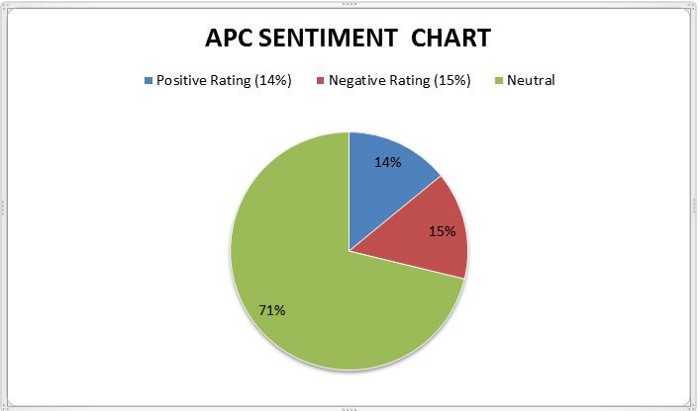
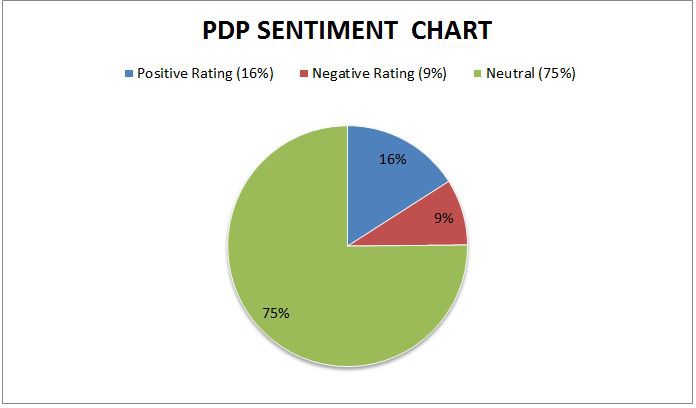
In the next distribution we will be looking at comparing related data side by side to give us a holistic view of what is really happening.

Yes, we also have to factor in the sentiments for the Vice-Presidential candidates as we believe that will play some role (although of lesser weight) in overall outcome of election.
In perspective, we want to now see how each of these distributions stack up in overall weight for the winner of election.

To arrive at our final analysis, we will appropriate weights to each color and multiply by the value each color carries. Each value is a final rationalization of both the positive and negative sentiments respective to each variable.
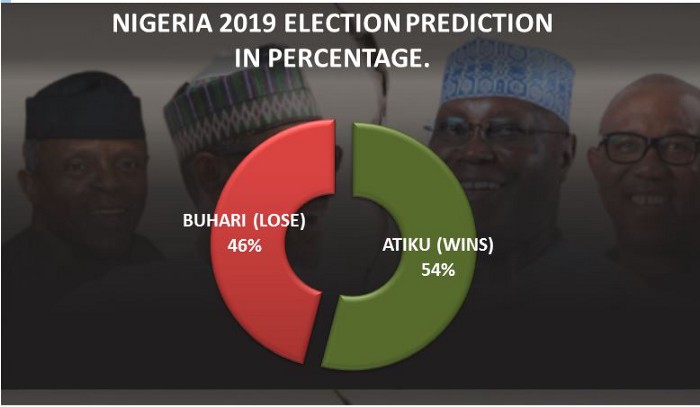
That is, the rationalization of both the positive and negative sentiments for Buhari gives him a total score of 226 and that for Atiku gives him a total score of 314. The same rules apply for the represented political parties and the Vice Presidential candidates.
Once weight are applied and values processed. The final percentage score for each candidate is used to predict the final outcome of the Nigeria 2019 election.
Buhari rounds up to 46%, while Atiku emerges with 54% as shown in the distribution below.
GOING FORWARD — VALIDATING DATA
We continue to monitor the sentiment trends of Nigerians online, as of our most recent stream at the time of publishing this report, we see Buhari trailing below in the negative trend (we suspect the recent Kaduna killing may be a causative factor), while Atiku has a good positive sentiment building for him. See graphical distribution shown below.

CONCLUSION
The design of this project is purely for research purpose. It is designed to explore how the sentiments of online users can translate to actual actions. In this case, the sentiments of Twitter users in relation to the Nigeria 2019 general elections.
A similar approach was used during the US 2016 general election, to understand the voter sentiment distribution between President Trump and Hilary Clinton.
We understand some of our various limitations in this case, we do not lay claim to sufficient data. But overall we believe the methods utilized here can form a foundational structure if given more data and more efficient computing resources for predicting election outcome.
We also understand the many other factors not considered here such as, unrepresented eligible voters (especially in rural areas) in online spaces such as Twitter. And the claim that the majority of Twitter users are “Talk and NOT do” that is inactive voters. We believe the idea is to represent their sentiments, which is a sample of real-life, everyday Nigerians.
We also understand the fact that underage voters can influence numbers especially in many Northern states; and the fact that election rigging may alter all the critical conclusions of the biggest datasets and finest algorithms.
But all in all, we believe that, with more Nigerians coming online, and student/young population becoming the highest represented demographics in the INEC voters book, predictive tools such as the one used here will play a more active role in election processes and lead to an improved credibility system for checking against fraudulent outcomes in elections.
DISCLAIMER: This is intended strictly for research purpose in the field of AI, Machine Learning and Data Science.
It does not in anyway validate any political candidate or gives room for this to be hijacked as a political campaign edge for or against any political candidate or party.
Personally, I am looking forward to a successful election run(Nigeria 2019 Election) and wishing everyone (especially the NYSC adhoc staffers) safe during the period.
In another project, we will be collecting data to analyze the sentiments of Nigerians on the election process and results. It will cover the sentiments of how Nigerians feel about the way INEC ran the 2019 elections.
- Published in Artificial Intelligence, Business & Economy, Data Science, Software
THE FUTURE OF WORK TALE AS TOLD BY THE LUDDITES
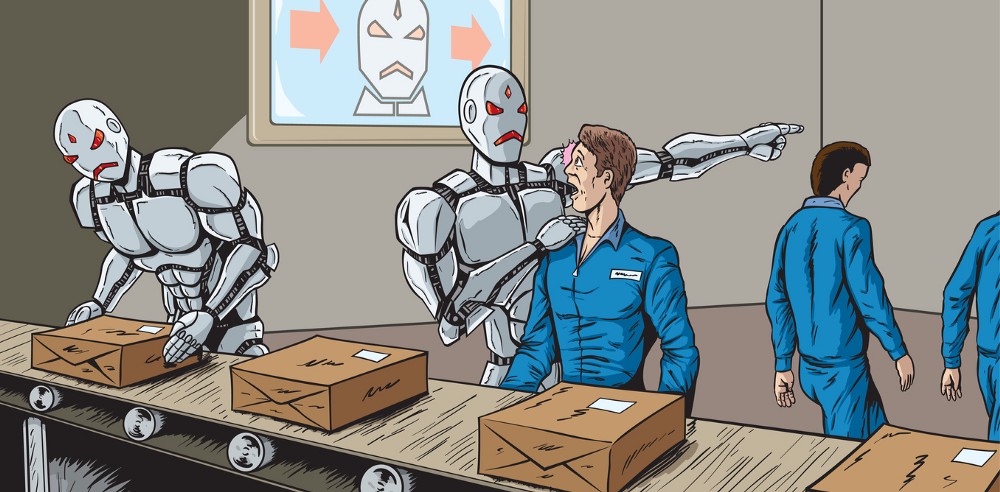
It was the year 1823, in the gallows with the noose around their neck were fourteen people to be hanged. Amongst these condemned men was a 16 year old boy crying out to his heart-broken mother in the watching crowd to help him.
But the boy’s mother was powerless to do anything that could save her son. She could only wail in despair and watch-on with a broken heart, as the final orders where given and her son struggled to fight with his last strength, the suffocating and biting pains brought by the rope around his neck. In no-time, the boy hung lifeless, his body swirling slowly from side to side as if to wave a final goodbye to a world he could not seem to understand.
The crowd looked on in helpless grief at the fourteen lifeless men, some of them fathers, husbands and lovers, brothers and uncles. This sentence to death by hanging was issued from the highest place of government, the crime committed was that these men where luddites.
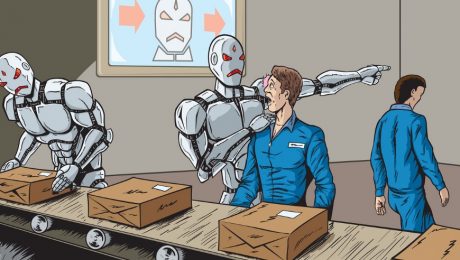
Their jobs and means of livelihood were under attack by advancing technology, and they fought back the best way they knew. And so ended their tragic heroism; their story forever a testament that; technology and automation has the power to disrupt both positively and negatively.
Whenever an article about job loss due to technological advancement and automation is written, the Luddite story is always used as the perfect exemplum.
So who were the luddites and what crime did they commit really?
The Luddite movement began around the year 1810, it was made up of men whose profession at the time was in the textile industry. This included weavers, stocking makers and embroidery specialist. These were high paying professions at the time, but soon, new types of machines were invented. These machines could automate the work of making stockings and textile making with very little human input.
This resulted in entrepreneurs with access to huge capital to set up big factories, which in turn led to more and more handcraft workers going out of employment. These former craftsmen formed themselves into groups called the luddites and went about destroying the new machines, burning the factories and even killing some factory owners.
The issue escalated into a national threat, which involved the British parliament passing legislation against luddites who destroyed machines or burned down factories. Thousands of soldiers were deployed to the towns where the Luddite movement was prominent, and after a number of clashes, the Luddite revolution was eventually subdued by force and a show of public execution by hanging as the one described earlier.
The looms that marked the Luddite movement are today weaving threateningly around our world at a global and existential level. Our only safeguard is to learn and adapt the lessons from this momentous historical face-off between man and machines; as they contend for supremacy in the job market.
Just like the Luddite narrative where different stakeholders (workers, factory owners, & government) had a significant role to play in the final outcome of the story, the job disruption face-off we will experience going forward into this new era will also require the pro-active harmonization of thoughts, policies and end goal for all parties. From the individual, to the employers of labor, to regulatory government bodies; all will need to reconcile to the fact that they face a common threat, and that they must be united to defeat this common enemy.
***FUN FACT***
Duriing the Ludite revolution, one of the very few legislators who advocated for the Luddites was Lord Byron. Coincidently, Lord Byron’s only legitimate daughter Ada Lovelace would become the first computer programmer by combining the technology of the Analytical Engine with the Jacquard loom.
This ironic thread has stretched even to our times, and is woven with the looming job-loss predicament we find ourselves today. For AI and Automated Machines need programming which to a great extent can be traced back to Lord Byron’s daughter — Ada Lovelace.
In the coming chapters of this book, I will be discussing some of the possible ways workers/individuals, employers (soon to be employers of robots & automated machines) and government through its legislative arms and agencies can avoid the tragic route of the Luddite-type scenario.
From the one end of the individual laborer to the farthest end of Government policy makers, everyone needs be involved in finding the most agreeable means for dealing with this encroaching robot and AI automated army.
By being futuristic and pro-active, Government will have little need for anti-riot police. On the other hand, owners of industry and employers of labor will have no fear of being stigmatized or attacked by disgruntled workers. And most importantly, the worker whose job will be swallowed up in the robot and AI automation deluge will find solace in the fact that they had anticipated such a scenario and prepared for it long before it could affect them negatively.
HOW ARTIFICIAL INTELLIGENCE AFFECTS SOCIAL MEDIA

There is big confluence between AI & Social Media. It is a two way thing, AI not only affects Social Media, Social Media also plays a great role in the development of AI.
The way AI is developed is through data, large data (big data) and one of the easiest ways to generate and source for data at this scale is from the contents and interactions on social media.
Most social media platforms operate at scale, so for issues such as monitoring or censorship of what is being posted, the admin of these platforms have to use automation and AI for its management and policing.
AI algorithms such as sentiment analysis or recommendation engines (used by Facebook & Youtube to recommend posts based on the AI understanding of what you will like) are very much an integral part of any social platform architecture.
AI is integral to how and when Adverts are delivered to you on social media. AI controls the engagement levels on your posts and ensures that people who are most likely interested in the topics or communities you belong to get recommended to you as connection; this is because engagement is key goal for every social media platform.
So as you can see, AI plays a very critical role in social media. But beyond this, it is also important to mention that not all the effects of AI on social media are positive ones. For example, AI ensures a never ending supply of content recommendation (recommendation engines) that can keep you engrossed in social media, using time in an unproductive way.
AI being used as an automated censorship tool on social media platforms can also mean that humans may no longer have complete control over what free speech should mean or how dissenting views can be morally managed.
Most AI algorithms used for social media are optimized for profit, benefiting the Advertisers, getting the users dopamine-addicted, and biased to fringe or contrarian views on their platforms.
Overall, the role of AI in social media cannot be diminished. It will continue to grow even deeper and more integral as we continue to generate more data on these platforms. AI models such as GPT-3 are benefactors to the rich data AI can be trained on from Social media.
We only need to learn more on how to make AI an agent for good (AI4Good) as it helps us to make social media more meaningful.
I talked a great deal about AI and its effect on the future in this book. 2020s & The Future Beyond.

- Published in Artificial Intelligence, Digital Transformation
7 KEY STRATEGIES FOR IMPLEMENTING A SOLID DIGITAL TRANSFORMATION IN YOUR BUSINESS


With the right Digital Transformation strategy, your business can weather almost any storm & become positioned for long term success.
Kelly Idehen
So how do you bring about Digital Transformation for your business, whether new or old? Below I will share with you 7 key strategies you must consider.
7 KEY STRATEGIES
1. Don’t be afraid of New: Don’t be afraid to try something new outside the old traditional way of doing things. Phones were supposed to be designed for call alone, but one day somebody decided to put a camera in a phone. Today, a phone without a camera cannot be considered as a phone, today, a phone is rated by the power and quality of its camera. So, to succeed at digital transformation you must first remove fear, learn to break and decouple things. Learn to try out new ideas and explore new processes.
2. Re-align Your Business Model: Most businesses are currently operating without a dedicated business model. Many business owners don’t even have an idea what a proper business model canvas should look like; this is dangerous. If you want to have a safe and successful digital transformation, then you must ensure you first develop a well-structured, flexible and modern business model. Develop a clear view understanding of all the small important moving parts in your business, only then can you properly plug-in digital transformation into it.
3. Shift from Survival to Thrive Mentality: A lot of businesses are merely ‘just’ existing; hoping that someday things will miraculously get better. This is a very dangerous hope to assume. For some business, all they can think of and plan towards is how to survive the current month and pay their workers salary. With this kind of mentality, your business will not go very far. Do what you must to move away from the survival mentality, reinvent your business in such a way that the general attitude and focus is how to thrive and blossom instead of merely surviving. Innovation is the key to beat this stagnancy where many businesses lie and wither away.
4. Retrain, Retool & Re-kit: Many businesses are stuck with the workforce and mindset of older generations. They still use outdated technologies and operate in the same ways and models since the company was founded. In this fast paced and easy to disrupt business environment, every business must ensure they are stocked with a dynamic, creative, and well trained workforce. They must always be on the search for tools and technologies that can give their business the additional advantage.
5. Float like a butterfly, Sting like a Bee: Most of the successful business in Silicon Valley used this strategy. The strategy of lean operation, the strategy of accepting and learning from failure. In fact, failure was almost celebrated as a culture. This attitude, coupled with lean and flexible operational models allowed for different kinds of iterations which helped many Silicon Valley businesses grow fast, and grow fat. So to succeed at Digital Transformation follow the Muhammad Ali model of floating like a butterfly and stinging like a bee. Make your business operation lean, be flexible enough to iterate on new models, strategies and tools. Move fast, fail faster, but most importantly develop a structure that can allow easy scaling of your business.
6. Go Beyond Customer Management – Deepen customer experience and customer relationship: As the competition becomes stiffer and profit margins become tighter, customers will be the ultimate deciders for whether your business thrive or not. To remain relevant, every business will need to find creative ways to add value for their customers. The best way to achieve this is by deepening customer relationship, fostering customer engagement and optimizing customer experience. In a world where the United States president can without protocol, Tweet at anyone and in a world where a dissatisfied user can bring down your brand reputation with a viral Instagram video; every business needs to understand the importance of making themselves available for active engagement on digital platforms. The goal is to by whatever means, ensure that the customer knows and see that your business is always willing to listen to their concerns and that you care deeply about their unique challenges. Don’t just build a customer base, build a loyal customer community.
7. Keep your eyes on the horizon – Develop your own emerging technology strategy – R&D: In the year 2007, Nokia had over 50% of the market share for mobile phones. They were the undisputed champion when it came to the phone market, but by 2013 (less than 7 years later) they only had about 3% of the mobile phone market which was now being dominated by the Apple through their IPhones and Android phones from SamSung, Sony et al.
Today, technological platforms like social media has disrupted print advertising, crypto-currencies are threatening old financial institutions, ecommerce platforms like Amazon, Alibaba and Jumia are threatening physical shopping done on brick & mortar stores. As the cliché goes, “The only thing that is constant is change”. Preparing your business for change before it happens is the smart way to go.
Every business needs to have an emerging technology strategy; your business needs to be active in research and development of new service channels or products that will add value for you and your customers. You need to explore possible ways in which emerging technologies like AI, Blockchain, Virtual Reality, 3D printing etc. can be integrated into your business processes to optimize value for your product or service offerings.
To survive the business landscape of the future, you will need to have a digital transformation strategy. I have shared 7 key points you should take into account if you want to make your business resilient and digitally sturdy to weather the storm of disruptions that will come upon every business now and in the future.
Like the bible story of the 10 virgins, 5 were wise and brought extra oil for their lamp, the other 5 were classified as foolish, they didn’t think it important to come prepared with extra oil. At midnight when light was most needed, only the 5 wise virgins were prepared with lamps burning bright.
This analogy fits perfectly into the business clime today, the question is, will your business start the preparation today to add in the much needed extra oil of digital transformation?
Or you want to wait till the midnight of crisis and run around in panic looking for extra oil? This is the great call for every business today.
In my book, 2020s & The Future Beyond, I share some very revealing insights on what the future for business will look like as the fourth industrial revolution (#4IR), Artificial Intelligence, Robots and other emerging technologies bear down on us. Click here to learn more.
**********************************************************

2020s & The Future Beyond, is a book that dives deeply into what the future of this decade and the ones that will come after will look like; especially as it relates to the development of AI and other emerging technologies. Click here to learn more.
- Published in Business & Economy, Digital Transformation